Will RFID tags work on metal tools and equipment?

An RFID tag on a metal surface usually works, but only if the tag was built for metal. A plain label tag pressed flat onto steel often stops reading altogether, and the reason is antenna physics rather than the price of the tag or the quality of the reader.
One case is worth stating before the rest. Tagging small steel hand tools individually is close to the worst case for passive UHF, and no amount of tuning fixes it. Everything below is about the wide middle ground where metal is a solvable problem: instruments, cases, machines, moulds, cabinets, racking and larger equipment.
RFID does not read through metal either. A tag sealed inside a steel enclosure will not answer, which is why the tag goes on the outside of the cabinet even when the asset lives inside it.
The metal becomes part of the antenna
A passive UHF tag is a printed antenna with a chip in the middle and no battery of its own. The antenna has a length, and that length is tuned to the band the reader uses, which for EPC Gen2 falls somewhere between 840 and 960 MHz depending on the country. The reader's field wakes the chip and the chip answers by reflecting a modulated signal back, and all of that is paid for out of the energy the antenna manages to collect.
An antenna does not stop at its own edge. Whatever sits within a few millimetres of it becomes part of the electrical picture, and a conductive surface is the most aggressive neighbour there is. Press a plain label tag onto steel and what you now have is not the tag you bought.
Two different failures that get called the same thing
People say metal kills RFID for two problems that behave nothing alike, and telling them apart is most of the diagnostic work.
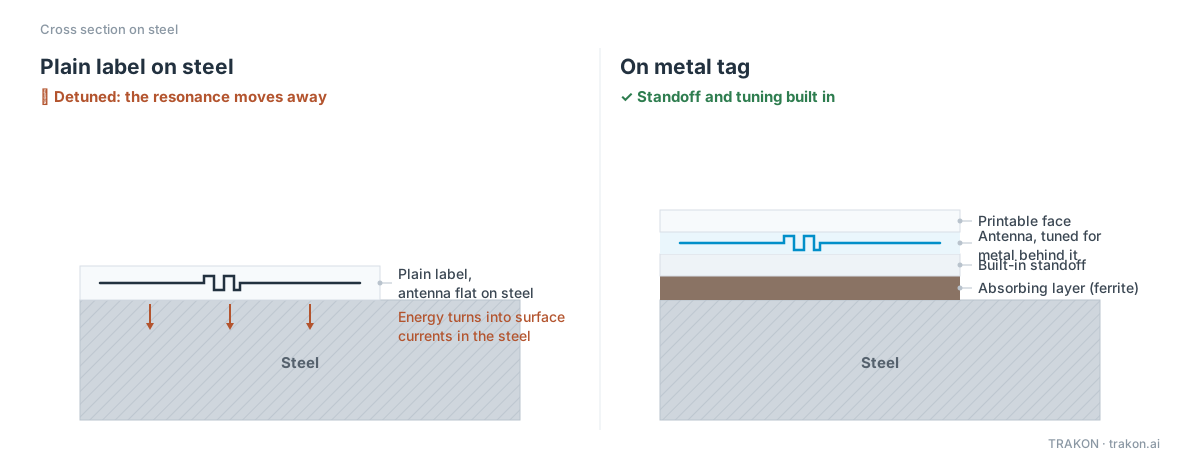
Detuning happens at the tag. The conductive surface directly behind the antenna shifts where it resonates and drops how efficiently it collects energy. The tag is undamaged and still trying, but it is now tuned somewhere the reader is not listening. The symptom is total: the tag reads on the bench, you stick it on the asset, and it never reads again, at any distance, in any orientation.
Reflection happens in the room. Steel racking, shelving, cabinets, the machine next to it and the tool underneath it all bounce the reader's field around. Reflected waves add up in some places and cancel in others, so the field has strong spots and dead spots close enough together that moving an asset along the same shelf, or turning it round, can decide whether it reads. The symptom is intermittent: it reads from the aisle but not from the doorway, standing up but not lying down, with the drawer open but not with it closed.
Detuning is a tag selection problem. Reflection is a placement, orientation and procedure problem. Chasing one with the fix for the other is how a deployment burns its first month.
| Symptom | Likely cause | First thing to try |
|---|---|---|
| Never reads once fitted, reads fine off the asset | Detuning against the surface | A tag designed for metal, not more reader power |
| Reads at some angles and not others | Reflection and tag orientation | Move the tag to an edge, change its orientation |
| Reads alone, disappears in a stack or a full drawer | Neighbouring tags and surfaces | Present items more openly, or tag the container |
| Read fine for weeks, then stopped | Physical damage, paint, solvent, heat | Inspect the tag before you blame the radio |
What a spacer does, and what a metal mount tag is
Lifting the antenna off the conductor changes the coupling between them, so a few millimetres of standoff can change behaviour dramatically. That is real, and it is why a scrap of foam under a dead label sometimes brings it back to life.
Treat that as a diagnostic rather than a solution. If foam revives the tag, you have proved the failure was detuning. What you have not built is a repeatable installation, because the working thickness depends on that specific tag design and that specific object, and nobody can hand you a thickness rule honestly. Measure it on your own asset, or buy a tag that already solved the problem.
Tags built for this job are sold as on metal, metal mount or anti metal tags, and the useful ones are not labels with a thicker liner. They are antennas designed on the assumption that a conductive plane sits behind them, with the standoff built in and the tuning done accordingly. A conductive backing is not automatically the enemy: a well designed metal mount tag uses it, which is also why some of them read worse in free air than an ordinary label does.
What is doing the work inside a good one is usually more than air. An absorbing layer, most often a ferrite, sits between the antenna and the metal and takes up energy that would otherwise go into surface currents on the steel, which is why a thin on metal tag can beat a plain label sitting on a much thicker pad of foam. Our own write up on absorbing materials in on metal tags walks through the material families if you want the mechanism rather than the summary.
Choosing the tag, and how it gets fixed on
Two decisions usually get made at once, and they interact.
The form factor is a trade between size, survival and range. A thin on metal label fits where nothing else will, prints like an ordinary label, and takes abuse worst. An on metal hard tag survives a workshop and generally reads better, because there is room inside the housing for a proper antenna and a designed standoff, and it costs more and needs somewhere to mount. The housing is the other half of that decision: engineering plastic and ABS for general workshop use, ceramic and PCB where the tag has to be small and hard, PEEK and TPU where heat or flexing is the problem. Screw mount and cable tie versions exist for pipes, handles, frames and rack uprights, where there is nothing flat to stick to.
How it is fixed on is not a detail, because the fixing sets the standoff and the standoff is part of the tuning. Adhesive is fine on a clean dry surface and is the usual failure point on oily, cold, painted or freshly machined steel, so degrease first and expect to lose the ones you did not. Rivets and screws need a hole or a bracket and give you a tag that is still there next year. Cable ties move, which is acceptable on a pipe and a problem on anything you want to read from a fixed position. If you change the fixing method later, test the read again, because you have changed the geometry that made it work.
Small steel hand tools
A UHF antenna needs physical length to be efficient at these frequencies. Small metal mount tags exist and you pay for the size in range: the smaller the tag, the closer you have to be, and the smallest ones have to be read up close rather than from across a room. Now think about a spanner, a drill bit, a socket or a file. Every surface is conductive, every surface is small, most of them are curved, and the whole thing gets thrown into a drawer with dozens of its neighbours doing the same thing to the field.
You do not tune your way out of that. What is left is a set of choices you make deliberately: tag the case or the kit instead of each piece, tag the drawer or the bin position and manage the contents as a set, use a different technology for that class of item, or decide those items are not tracked individually. Any of those four is a defensible answer. Buying five thousand small tags and hoping is not.
Liquid is the same conversation
Water is lossy at these frequencies. It absorbs energy, and it also loads the tag antenna and moves its tuning, so a tag on a full container behaves differently from the same tag on an empty one. If you are tagging drums, jerrycans, coolant containers or anything else whose contents change, test it full and test it empty, because the state you did not test is the state that fails during the count. The usual answer has the same shape as the small tools answer: tag the pallet, the rack position or the cage instead of fighting the physics on every container.
Placement is not a detail
- Find the edge. An antenna hanging slightly proud of the largest flat conductive face, or sitting on a nameplate, a plastic handle, a plastic housing or a moulded recess, behaves better than one pressed into the middle of a steel panel.
- Pick an orientation and keep it. A tag antenna is a dipole, so how it sits in the reader's field changes how much energy it collects, and a metal surface bends that field locally. You are not going to calculate this, you are going to try it, and then you are going to write down which way round it goes.
- Put it in the same place on every unit. Consistency is not tidiness. It makes read behaviour repeatable, it makes a failure diagnosable, and it gives the person doing the sweep one habit instead of a hundred exceptions.
- Assume it will be abused. Tags on tools and machines get painted, wiped with solvent, scraped along racking and heated. Ask what will happen to the tag after it is fitted, and choose the housing for that rather than for the bench test.
How to find out, on your own assets
There is no substitute for a bench test on the real thing, and it costs almost nothing.
- Take the actual asset, not a similar one. Steel thickness, curvature, coatings and what is inside it all matter.
- Test the worst case, not the showroom case. The instrument at the back of a closed steel drawer. The case in the middle of a stack. The tool lying flat against a rack upright.
- Step the distance with a tape measure. Keep the reader still, move the asset away, and record where the read stops. Treat the result as a ranking between candidate tags rather than a measurement of range, because the number belongs to that room and that day.
- Try more than one unit and more than one tag design. Two tags that look identical in a catalogue can behave differently on your surface, and a single lucky sample proves nothing.
- Fit them the way you will fit them in production, with the same adhesive or bracket, and then repeat step 3. A tag tested loose and fitted differently is an untested tag.
- Then order quantity. Sample tags are cheap, and five thousand of the wrong tag is an expensive way to learn about detuning.
What this looks like in TRAKON
TRAKON does not change the physics. What it changes is how quickly a wrong tag choice gets found, and how much it has cost by the time it is.
Test with the reader you will actually use. If counts will be done with the AZH-P1 handheld, rank your candidate tags with that handheld, on your own assets, at the distances your rooms actually have. If the door is the point of the project, the final test is the doorway itself: a metal case crossing at walking pace gives a Guard Basic checkpoint one short window to read it, and a tag that has only ever passed on a bench has not passed that.
After rollout, the count data keeps watch. Count Basic classifies every EPC in a spot check as confirmed, missing or unexpected, and a wrong on-metal choice leaves a recognisable signature: the same few assets missing from every count while sitting in plain sight, all of them steel. When that pattern shows up, suspect the tag before you suspect theft. Running one of those checks from scoping to reconciliation is a short procedure.
Tags are quoted separately from the software and the readers because the right tag depends on the surface it is going on, and that surface is on your asset, not ours. Tell us what you are tagging and what it lives in, and you will get a more useful answer than a part number.
The short version
Metal does not simply block RFID, it retunes the tag and reshapes the field. Choose a tag built for a conductive surface, fix it at an edge and fix it the same way every time, test the worst case on your own assets before you commit to quantity, and accept that a class of small steel items is better tracked by its case or its location than piece by piece. That last one is the sentence most projects skip, and it decides whether anyone still trusts the count a year from now.
If you are still deciding whether radio is the right answer at all, RFID vs barcode for asset tracking covers what changes when you stop pointing a scanner at things.
TRAKON is built and supported by ACCUZ® Industries.