Does RFID show you where an asset is right now?

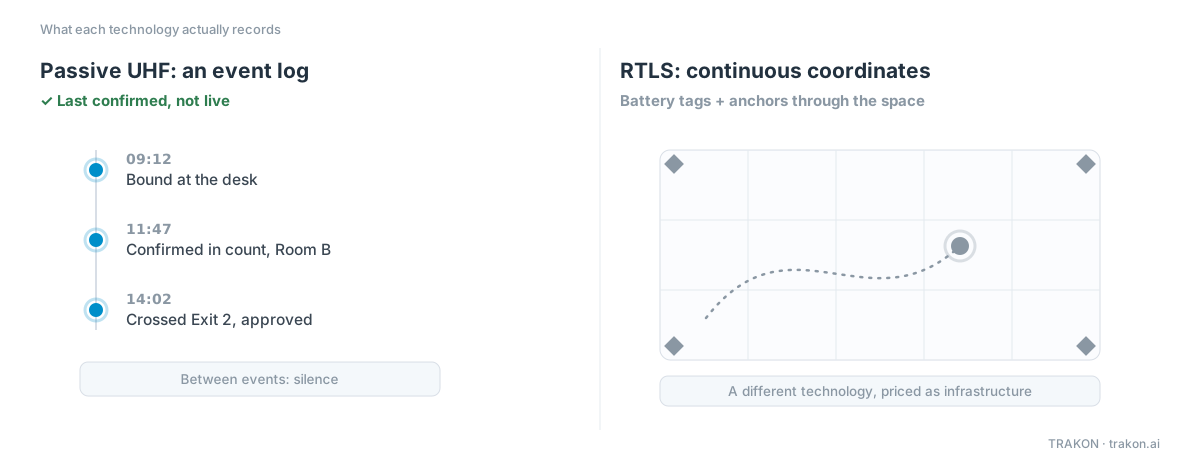
No. A passive UHF RFID system does not put a live dot on a map, and it is worth settling that early, because the gap between what people picture and what the technology does is where budgets get spent twice. What RFID gives you is presence: proof that a specific tag answered a specific reader at a specific moment.
That sounds like less than you wanted, so it is worth being precise about what presence buys you. Most of what gets called a location problem in a workshop or a warehouse is really a handful of smaller questions, and presence answers them for far less money than a live map ever could. The live map exists too. It has its own name, and it gets its own section below.
Why a passive tag cannot report its position
A passive UHF tag (EPC Gen2) has no battery. It is an antenna and a chip, and it speaks only when a reader's field wakes it. The moment the tag leaves that field, it goes silent, and nothing anywhere is tracking it.
Consumer gadgets have trained everyone to expect otherwise. A phone or a key finder reports its position because it carries a battery and a radio that phones home, and you pay for that in hardware and battery care, per item. A passive label carries neither, which is exactly why you can afford to put one on five hundred tools. The trade is silence between reads. What your system knows about the world is an event log, not a radar screen.
What you actually get: a last confirmed position
In TRAKON, four kinds of event write that log.
| The question you are really asking | What answers it |
|---|---|
| Who has it right now | The borrow record from the workstation: badge, asset, timestamp |
| Is it still in the room | The latest spot check: confirmed, missing or unexpected |
| Did it leave the building | The exit checkpoint event, with approval state |
| Where exactly is it this second | Nothing passive answers this. You go and find it, see below |
Notice how much of "where is it" dissolves once the first three are answered. An asset on loan is not lost, it is with a person, and a person can be asked. An asset confirmed in last week's count and absent from today's has a bounded search area and a time window. An asset that crossed an exit without approval is not a search problem at all, it is an incident with a timestamp.
A sweep with a handheld reader down an aisle refreshes hundreds of those last-seen records in one walk, which is the practical difference between RFID and barcode counting covered in an earlier article. Running that sweep as a scoped check, and reading what comes back, is a procedure of its own.
Finding one specific item is a search, not a lookup
When you do need the thing in your hands, Count Basic treats it as what it physically is: a search with a shrinking radius. In the product this is a feature called Locate, and it runs as a task sent from the web to a handheld.
Dispatch. Locate starts in one of two places. Next to a Missing row in a finished spot check, so the count itself hands you the search. Or from any asset record, when someone simply cannot find something. Either way you choose which handheld to send it to and a search timeout, five minutes by default. One detail worth knowing before you rely on it: the handheld does not switch tasks by itself, so whoever is holding it has to refresh the task list and open the Locate task.
The search. On the handheld, the target reads Target detected with a live RSSI value that climbs as you close in, and you can raise or lower the reader's transmit power to widen or tighten the search as you narrow down. Signal strength is not distance. It bends with tag orientation and with whatever the room reflects, so treat it as a compass that occasionally lies rather than a tape measure. It still ends in minutes what used to eat an afternoon.
The last metre. Assets whose tag is flagged as an LED tag on the asset record get one extra button: LED Pulse, which flashes the tag's own light. Plain tags do not have it, and that is the honest difference between hunting a signal bar and simply seeing the thing. Light and eyes finish what the radio started.
The result is data, not just relief. You end the task with Confirm Found or Not Found, and the attempt is written back to the asset's Locate History and to the reports: started, found or not, and where the request came from. Over months, that history shows you which assets keep going missing.
If you truly need a live map, that technology exists, and it is not this one
Continuous, real-time coordinates on a floor plan is what RTLS does: real-time location systems. Tags carry batteries, the building carries fixed anchors or receivers installed through the space, and the system computes positions continuously. It is honest, mature technology, and it is the right answer when the position itself is the operation: vehicles moving through a yard, flow analysis, safety zones around machinery.
It is also a different commitment. Powered tags need buying and maintaining per asset, anchors need mounting and cabling through every covered area, and the whole thing is priced and installed like infrastructure, because it is. We do not sell RTLS. This article exists partly because specifying RTLS-grade infrastructure for what turns out to be a custody and counting problem is an expensive way to arrive at the right answer.
The test is one question: do you need to watch things move, or do you need to know who has what, whether it is still here, and where to walk when one goes missing? If it is the second, presence does the job, and does it with tags that cost a fraction of a powered beacon and need nothing after binding.
What this looks like in TRAKON
The moment someone asks "where is the torque wrench", the system has usually already answered a better question. The Asset Basic borrow record says whose hands it is in. The last Count Basic spot check says which room answered for it most recently. A Guard Basic checkpoint says whether it ever left, and whether that exit was approved. The handheld locate is for the residue: the item that is somewhere in this room, bound, unborrowed, and refusing to be seen.
What TRAKON will not do is draw that wrench moving down a corridor. When you are comparing quotes, the useful question is simply which of the two things you are being offered: presence at read points, or continuous position. Both are real, they cost very different money, and knowing which one you need is most of the decision.
The short version
RFID does not show you where an asset is right now. It shows you where it was last confirmed, who took it, whether it left, and it hands you a Locate task on a handheld: hot and cold by signal, a blinking LED for the final metre, and the attempt logged either way. That answers most of what "where is it" means in a real facility. When it does not, what you are shopping for is called RTLS, and it should be budgeted as infrastructure, not as tags.
TRAKON is built and supported by ACCUZ® Industries.